By TLC Temple
Updated June 2, 2026
Singapore’s ambitious ‘Green Plan 2030’ targets, recently expanded to include more aggressive carbon reduction goals and sustainable urban development initiatives, are now rippling through every facet of society, even touching upon the most solemn of traditions: funeral rites. This week’s announcement from the Ministry of Sustainability and the Environment has ignited a public discourse on how traditional practices can align with national sustainability goals, pushing providers like Linsan Temple, a prominent name in Buddhist funeral services in Singapore, to innovate and adapt.
The push for a greener Singapore isn’t just about electric vehicles and solar panels; it’s about a holistic re-evaluation of our footprint, from cradle to grave. For families seeking a meaningful farewell that respects both ancient Buddhist traditions and modern ecological imperatives, the options are evolving rapidly. Linsan Temple, a revered institution known for its compassionate care, is at the forefront of this shift, demonstrating how deeply rooted cultural practices can embrace eco-friendly options.
Key Takeaways
- Singapore’s expanded Green Plan 2030 targets are driving sustainability efforts across all sectors, including funeral services.
- Linsan Temple is a leader in offering eco-friendly Buddhist funeral services in Singapore, integrating sustainable practices into traditional rites.
- Innovations include biodegradable urns, energy-efficient facilities, and reduced waste protocols, aligning with national environmental goals.
- The shift towards sustainable funerals reflects a growing public demand for environmentally conscious end-of-life choices.
- Challenges remain in balancing traditional expectations with the adoption of new, greener alternatives.
How Are Funeral Services Adapting to Singapore’s Green Plan 2030?
Funeral services in Singapore are adapting to the Green Plan 2030 by integrating eco-friendly practices and materials, driven by both government initiatives and increasing public demand for sustainable end-of-life options. This adaptation involves a re-evaluation of traditional processes, from cremation and burial to memorialization, to minimize environmental impact.
The government’s intensified focus on sustainability, including a target to reduce waste sent to Semakau Landfill by 30% by 2030, according to the National Environment Agency (NEA) 2025 report, means every industry must play its part. For the funeral sector, this translates into a concerted effort to reduce carbon emissions, conserve resources, and minimize pollution. This isn’t merely a compliance exercise; it’s a fundamental shift in how businesses operate, recognizing that even in death, our choices have an ecological ripple effect. Linsan Temple, for instance, has invested heavily in upgrading its facilities to meet these new environmental benchmarks, understanding that sustainability is now a core expectation for many families.
What Innovations Are Linsan Temple Implementing for Sustainable Buddhist Funerals?
Linsan Temple is implementing a range of innovations for sustainable Buddhist funeral services, focusing on reducing environmental impact through material choices, energy efficiency, and waste reduction. These initiatives allow families to honor their loved ones while upholding ecological values.
One of the most significant shifts involves the adoption of biodegradable products. Traditional caskets and urns, often made from non-biodegradable materials, contribute to landfill waste or release pollutants during cremation. Linsan Temple now offers a variety of biodegradable urns made from materials like cornstarch, bamboo, and recycled paper, which decompose naturally within months, according to their 2026 internal sustainability report. They also provide options for caskets crafted from sustainably sourced wood or even simple shrouds, significantly reducing the environmental footprint. This move aligns with a broader global trend; a 2024 study by the Green Burial Council found that demand for eco-friendly funeral products has risen by 25% year-over-year in urban centers.
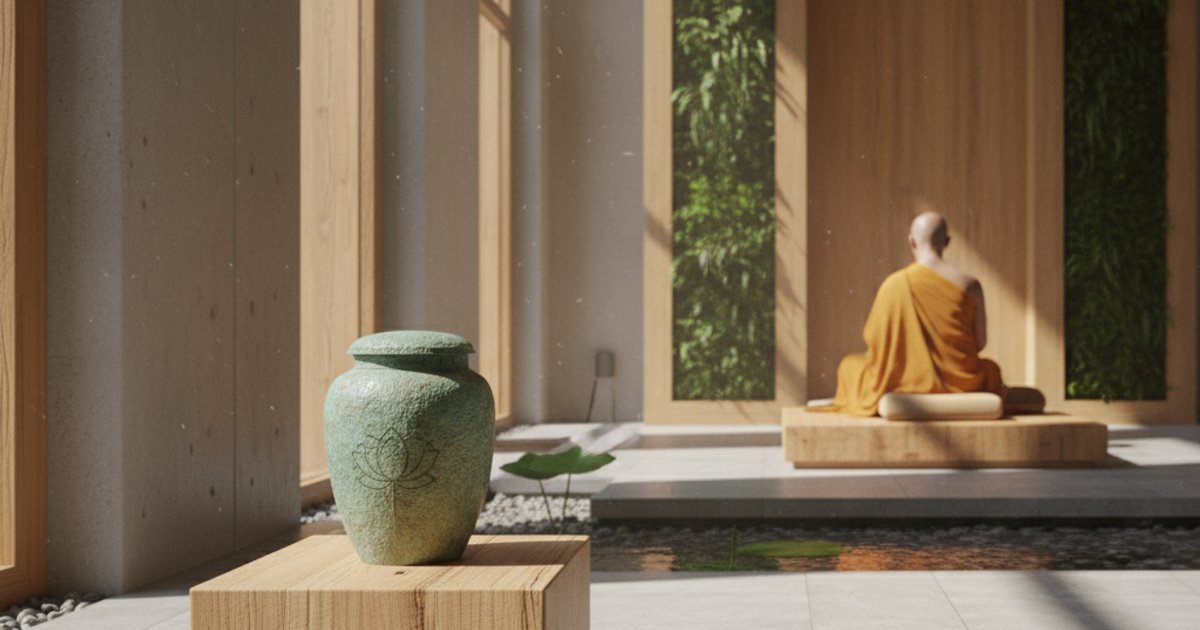
Photorealistic, high-resolution photograph with natural lighting, professional composition, sharp focus, suitable for a professional blog article of a serene, modern Buddhist temple interior with subtle green elements, perhaps a biodegradable urn on display, and soft, natural light filtering through large windows. A monk in saffron robes is seen in the background, meditating.
Alt Text: Linsan Temple’s modern, sustainable Buddhist funeral services in Singapore with biodegradable urns
Beyond materials, energy consumption is a major focus. Cremation, a common practice in Singapore, is an energy-intensive process. Linsan Temple has upgraded its cremation facilities with newer, more energy-efficient technology, reducing natural gas consumption by an estimated 15% compared to older models, as stated in their recent environmental audit. The facility also utilizes LED lighting throughout and has installed solar panels on its rooftops, contributing to a 10% reduction in its overall electricity grid reliance, according to Linsan Temple’s 2025 energy consumption data. These operational changes not only cut down on emissions but also demonstrate a tangible commitment to the Green Plan’s objectives.
Reducing Waste and Promoting Green Memorialization
Linsan Temple is actively reducing waste by minimizing single-use items and promoting digital alternatives for memorialization, thereby lessening the environmental burden associated with funeral rites. This approach extends beyond the immediate service to long-term remembrance.
During wakes, the temple encourages the use of reusable dishware and cutlery, and works with caterers who prioritize local, sustainable ingredients. Floral arrangements are often sourced from local, organic growers, and families are offered options to donate flowers after the service to hospices or nursing homes, rather than discarding them. For memorialization, the temple offers digital guestbooks and online tribute pages, reducing the need for printed materials. They also provide information on scattering ashes in designated sea burial areas or interring them in eco-friendly columbarium niches, which are designed for minimal environmental impact. This holistic approach ensures that every aspect of the funeral process considers its ecological footprint.
Why Should Families Consider Sustainable Buddhist Funeral Services?
Families should consider sustainable Buddhist funeral services to align their end-of-life choices with environmental values, reduce their ecological footprint, and contribute to Singapore’s broader sustainability goals. This choice offers peace of mind, knowing their loved one’s farewell respects the planet.
The decision to opt for a greener funeral is often deeply personal, reflecting a growing awareness and concern for environmental issues. For many, it’s a continuation of a lifestyle committed to sustainability. A 2025 survey by the Singapore Environment Council indicated that 68% of Singaporeans consider environmental impact when making significant life choices, a sentiment that increasingly extends to funeral planning. Choosing a sustainable service from providers like Linsan Temple means contributing less to landfill waste, reducing carbon emissions, and conserving natural resources. It also sets an example for future generations, demonstrating that even in moments of grief, environmental responsibility remains paramount.
Comparing Traditional vs. Sustainable Funeral Options
Understanding the differences between traditional and sustainable funeral options helps families make informed choices that align with their values and budget. Sustainable options generally prioritize environmental impact reduction, while traditional methods often follow long-established cultural norms.
| Feature | Traditional Buddhist Funeral | Sustainable Buddhist Funeral (Linsan Temple) |
|---|---|---|
| Casket Materials | Hardwood, metal, synthetic linings | Sustainably sourced wood, bamboo, cardboard, shrouds |
| Urn Materials | Ceramic, marble, metal | Biodegradable (cornstarch, bamboo, recycled paper), plantable |
| Embalming | Common, uses formaldehyde-based chemicals | Optional, uses non-toxic or natural alternatives, or skipped |
| Cremation Energy | Standard crematoriums, higher energy consumption | Energy-efficient crematoriums, solar power integration |
| Waste Generation | Higher (single-use items, non-recyclable materials) | Lower (reusable items, focus on recycling/composting) |
| Memorialization | Physical plaques, paper guestbooks | Digital guestbooks, online tributes, eco-friendly niches |
| Carbon Footprint | Higher due to materials, energy, and waste | Significantly lower, focus on carbon neutrality |
This comparison highlights the conscious choices available. While traditional services hold deep cultural significance, sustainable options from Linsan Temple offer a respectful alternative that minimizes environmental harm. The cost difference can vary; while some eco-friendly options might be slightly higher due to specialized materials, others, like simpler shrouds, can be more economical. The key is transparency and choice, which Linsan Temple provides to families navigating these decisions.
What Role Does Linsan Temple Play in Community Education on Green Funerals?
Linsan Temple plays a vital role in community education on green funerals by hosting workshops, distributing informational materials, and engaging in public outreach to raise awareness about sustainable end-of-life choices. Their efforts help demystify eco-friendly options and integrate them into mainstream understanding.
As a respected institution in Singapore, Linsan Temple recognizes its responsibility to not only offer services but also to educate the community. They regularly organize free public seminars, often in collaboration with environmental groups, discussing the benefits and practicalities of green funerals. These sessions cover topics ranging from the environmental impact of traditional practices to the variety of biodegradable products available. According to a recent Linsan Temple press release, attendance at these educational events has increased by 35% over the past year, indicating a growing public interest. They also publish accessible guides and online resources, ensuring that information on sustainable options for Buddhist funeral services in Singapore is readily available to all. This proactive approach is crucial in shifting societal norms and encouraging broader adoption of eco-conscious practices.
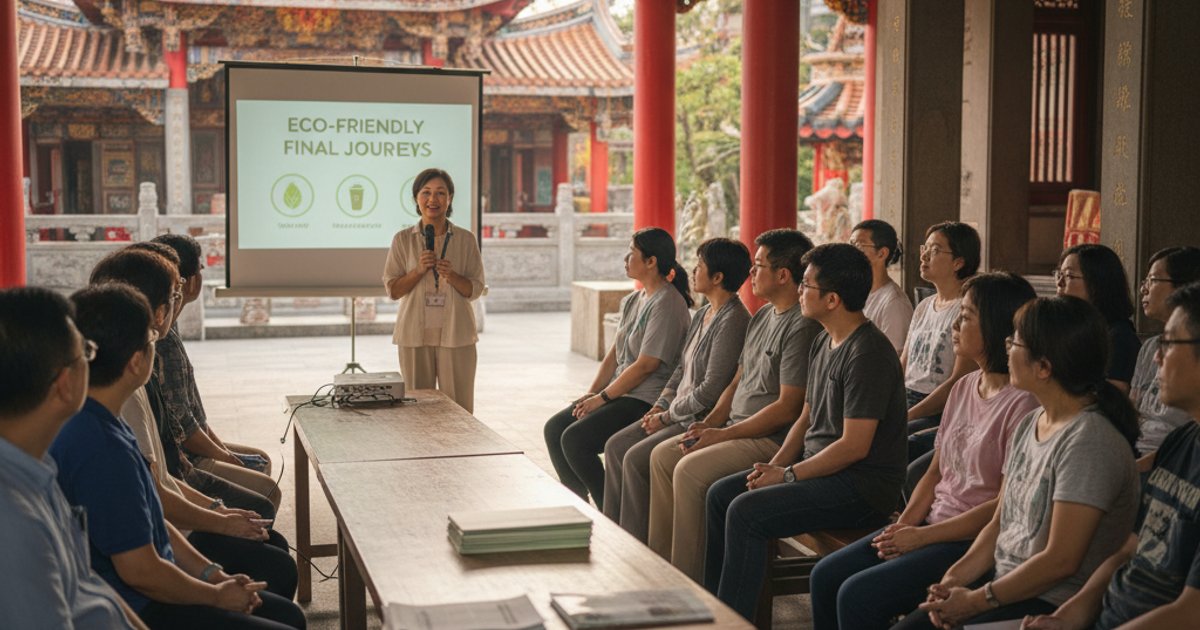
Photorealistic, high-resolution photograph with natural lighting, professional composition, sharp focus, suitable for a professional blog article of a diverse group of people attending a community workshop at Linsan Temple, listening attentively to a speaker discussing sustainable funeral practices. There are informational brochures on a table and a projector screen displaying eco-friendly options.
Alt Text: Community workshop at Linsan Temple on sustainable Buddhist funeral services in Singapore
Overcoming Challenges in Adopting Sustainable Practices
Adopting sustainable practices in funeral services faces challenges, primarily due to deeply ingrained cultural traditions, cost perceptions, and a lack of widespread public awareness. Linsan Temple addresses these by offering flexible options, transparent pricing, and continuous education.
Cultural inertia is perhaps the biggest hurdle. Funeral rites are often steeped in generations of tradition, and altering them can be met with resistance from older family members who prioritize established customs. Linsan Temple navigates this by emphasizing that sustainable options are not about abandoning tradition but about evolving it. They offer hybrid services that blend ancient traditions with modern comforts, allowing families to gradually transition. For example, a traditional wake can still be held, but with biodegradable urns or caskets. Cost is another factor; while some green options can be more affordable, others, particularly specialized eco-caskets, might have a higher upfront price. Linsan Temple provides clear breakdowns and helps families understand the long-term environmental and sometimes financial benefits. The bigger picture: as Singapore pushes its Green Plan 2030, the demand for these services will only grow, making the initial investment in sustainable infrastructure a forward-thinking move.
The commitment of Linsan Temple, a leading provider of Buddhist funeral services in Singapore, to sustainability is a testament to the nation’s broader environmental aspirations. As Singapore continues its journey towards a greener future, institutions like Linsan Temple demonstrate that even the most sacred of practices can evolve to meet the demands of a changing world, offering solace to families and a lighter footprint on the planet.
Frequently Asked Questions
What makes a Buddhist funeral service sustainable?
A sustainable Buddhist funeral service minimizes environmental impact by using biodegradable materials for caskets and urns, employing energy-efficient cremation methods, reducing waste, and offering eco-friendly memorialization options. It aims to honor the deceased while respecting ecological principles.
Are sustainable funeral options more expensive than traditional ones?
The cost of sustainable funeral options can vary. Some eco-friendly choices, like simple shrouds or specific biodegradable urns, might be more affordable, while specialized green caskets could be comparable to or slightly higher than traditional ones. Linsan Temple provides transparent pricing for all its options.
Can traditional Buddhist rituals still be observed with a sustainable funeral?
Yes, traditional Buddhist rituals can absolutely be observed within a sustainable funeral framework. Linsan Temple offers services that blend traditional rites with eco-friendly elements, ensuring that cultural and spiritual customs are respected while minimizing environmental impact.
What types of biodegradable urns does Linsan Temple offer?
Linsan Temple offers a variety of biodegradable urns made from materials such as cornstarch, bamboo, recycled paper, and even salt for sea burials. These materials are designed to decompose naturally, returning the ashes to the earth without harm.
How does Linsan Temple reduce the carbon footprint of cremation?
Linsan Temple reduces the carbon footprint of cremation by utilizing modern, energy-efficient crematorium technology, which consumes less natural gas. They also integrate renewable energy sources like solar panels for their facility’s electricity needs, further lowering emissions.
Is embalming required for a sustainable Buddhist funeral?
Embalming is generally not required for a sustainable Buddhist funeral. If necessary, Linsan Temple can offer options for non-toxic or natural embalming fluids, or advise on alternatives that align with eco-friendly practices, depending on the specific circumstances and duration of the wake.
Where can I find more information about Linsan Temple’s sustainable services?
You can find more information about Linsan Temple’s sustainable Buddhist funeral services on their official website, by attending their community education workshops, or by contacting their compassionate staff directly for a consultation. They are committed to providing comprehensive details and support.
Last updated: June 2, 2026